
1690: America’s first censored newspaper, contemporary free speech and human flourishing
The 1690 suppression of Publick Occurrences reveals the persistent tension between press freedom and state power

By J. Steven Bromwich
Who decides if you need to be cancelled?
Imagine you have just launched your first Substack or blog. The first days attract more readership than you ever dreamed possible. Your hard work is starting to pay off.
Then, four days after hitting the “post” button, the government shuts you down. Your writing dreams are shattered. What did you do wrong? Some anonymous bureaucrat disapproved of your content and cancelled you. You feel violated and for good reasons.
There is a greater likelihood today that your post or video will be directly censored by a private company, not the government. For example, social media companies may put a warning on your post or suspend your account for violating their “community standards.” Algorithms may engage in censorship. You may even be “fact checked” by a self-appointed media department. None of these are accountable to voters.
If not the government, tech or media companies, it is not too far-fetched to imagine a mob showing up at the door to intimidate you into silence.
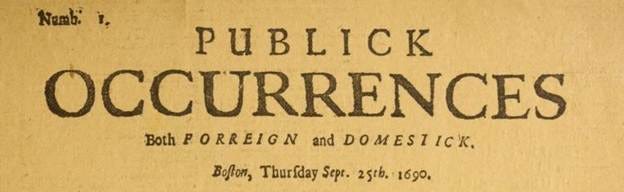
The first page of Publick Occurrences. Public domain. https://archive.org/details/publickoccurrenc1169unse/mode/2up
First American newspaper censored, cancelled and destroyed
Publick Occurrences Both Forreign and Domestick, the first multi-page colonial publication in 1690 Massachusetts was cancelled by the government. Colonial authorities (the British Crown) disapproved of content that criticized the government and the British military, and tattled on royals. It only took colonial authorities four days to put an end to the newspaper.
Benjamin Harris first published Publick Occurrences on September 25, 1690, and was officially banned and shuttered on September 29, 1690. Authorities ordered the destruction of every copy. None survive except one currently located at the British Library.
This did not stop Harris, a publisher and tireless supporter of free expression and free press. He forged ahead despite official government opposition. In addition to coffee house gatherings, Harris went on to print and circulate content for the public in the form of discreet fliers. He did not, however, attempt to publish another newspaper in the colonies.
Is it “free” if it is censored or needs government approval?
In 1704 the Boston News-Letter became the first continuously published newspaper, but at a price. John Campbell, its publisher, obtained government approval. The front page prominently displayed, “Published by Authority.”
If a media outlet needs government approval to publish content with its materials passing through a censor, is it free? Are we free people if information about public affairs has been scrubbed by a government bureaucrat before we see it, meaning vital information is missing? Do government authorities have the right to terminate a publication’s existence (or cancel a writer) even if it publishes unsubstantiated rumors, inaccurate content, or content that opposes official government positions? What if government uses proxies, like tech companies, to limit speech?
The First Amendment of the United States Constitution, ratified in 1791, resoundingly says, “no” to all these questions. The First Amendment exists to protect free speech from government oversight and threat.
“Congress shall make no law respecting an establishment of religion, or prohibiting the free exercise thereof; or abridging the freedom of speech, or of the press; or the right of the people peaceably to assemble, and to petition the Government for a redress of grievances.”
About a century after the colonial authorities shut Benjamin Harris’ Publick Occurrences down, the founders put these forty-five words into law intended to protect the right to speak and publish freely without fear of government censorship and other consequences. It is likely the American founders knew of his newspaper and what government authorities did to it.
1690 Media is named for the year Publick Occurrences was both published and shut down. Good public policy and the preservation of our republic require the ability of citizens to speak freely without fear of retaliation.
Historical struggles for freedom of the press continue
More than three hundred years later, the temptation and attempts to silence opposition voices and inconvenient speech endure. Attempts by the government to curtail free expression, including silencing the press, have been an ongoing struggle and debate throughout the history of the United States of America.
We will address the topic of free speech in upcoming stories. Relatedly, we will also address the recurring theme of the government, political parties, and the press colluding with each other to suppress opposing viewpoints.
A free republic must have free and honest media. Media that has lost its objectivity and colludes with political parties or corporate interests is not serving the public interest. Citizens need objective information. Government and State officials need to be held accountable. If we lose this freedom and accountability, we will spiral into corruption and cease to be free people.
Maintaining a free democratic republic requires knowledge, memory and vigilance
What we find throughout history is that nearly every new dispute over public policy, including government attempts to suppress speech, civil unrest, administrative overreach, homelessness, mental illness, political violence and others, have historical analogues. We examine these.
What is also true is that claims have frequently been made about human nature and founding principles by politicians, judicial actors, educators, media, activists and others that are false. These need to be corrected through objective evaluation and public conversations. Good policy decisions cannot be made without good information.
The mission of 1690 Media is to help readers recognize patterns in cultural upheaval and public policy challenges. We also commit to bring ethics to bear in the analysis of and writing about cultural issues and policy decisions. The good of the human person must always be at the center of policy discussions.
For more details on Publick Occurrences Forreign and Domestik see https://www.history.com/articles/first-colonial-american-newspaper-1690
Next week we will feature Elijah Lovejoy, often called the first martyr for freedom of the press. More importantly, however, he is a martyr for the dignity of the human person. He was willing to die for the most vulnerable and oppressed people of his era.
We invite you to join our mission by reading, subscribing, and engaging with our content.
J. Steven Bromwich is an investigative journalist who writes about culture, crime and human nature to help readers navigate modern problems with historical perspective and first principles. His background includes training and experience in criminal defense investigation, clinical ethics, nursing, history, and diplomatic studies. He is the founder of 1690 Media.
Boy, the more things change, the more they stay the same. What an excellent article connecting to what we are experiencing now to what our forefathers experienced in the British colonies. It is good to study and know history, for if not, we are destined to always repeat ourselves.