
Elijah Lovejoy: free press, mobs and redemption
The story and contemporary lessons of a murdered abolitionist journalist

Content Warning: text and images portray graphic violence
By J. Steven Bromwich
The Evolution of Silencing: From Literal Mobs to Digital Censorship
The desire to silence opponents is nothing new; it merely takes on different forms in new eras. Suppression of difficult truths happens on the macro and micro levels in everyday life. Suppression techniques are not new but have evolved with technology. Today, silencing, cancelling and reputation bombing of people and organizations that people find disagreeable occur in daily discourse, online digital hit squads (digital mobs), big tech, big media and old-fashioned mob violence.
Utilizing digital suppression through algorithms and account suspensions is also common, but less visible. Many people are unaware when information is omitted from searches or excluded from their feeds. This is censorship by other means. It is a form of manipulation by augmenting “desirable” political and social content while minimizing exposure to alternative viewpoints that do not align with the ideologies of the big tech of the day. It is the opposite of civil dialogue and antithetical to promoting a flourishing democratic republic.
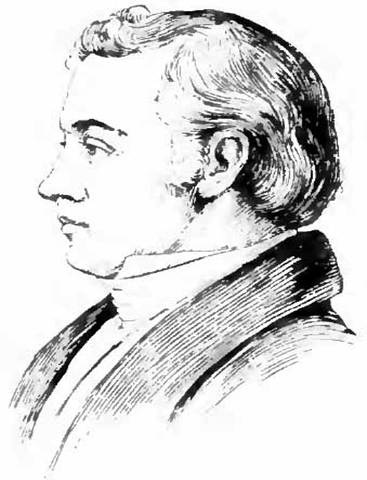
Elijah Lovejoy, 1802-1837. Public domain. (https://commons.wikimedia.org/wiki/Category:Elijah_P._Lovejoy)
Elijah Lovejoy’s evolving life of ministry and advocacy
The story of Elijah Lovejoy is an amazing story of zeal, personal transformation and the price he paid telling the truth and advocating freedom for enslaved black Americans. Lovejoy not only called for change, often in fiery rhetorical fashion, but became the change.
The power of Elijah Lovejoy lies in his own personal transformation, both as a man of faith and as an editor, and how it influenced his approach to addressing societal change. A horrifying event had a profound effect on Lovejoy was the brutal burning of the black riverboat man, Francis McIntosh, in 1836.
Elijah Lovejoy was born in Maine in 1802 and started his career as a teacher after completing college. After only one year of teaching, he moved to St. Louis, MO and worked as a journalist for various local newspapers. In 1832 he attended seminary in Princeton, NJ, and then returned to St. Louis, was ordained a Presbyterian minister and became a pastor in 1834. A short time later, both his activism and trouble began.
The most monumental events of Lovejoy’s life unfolded in turbulent 1830s America while he lived in Missouri and Illinois and worked as an editor of the St. Louis Observer and eventually the owner of the Alton Observer in Illinois. Violent mobs were erupting throughout the United States. There were many causes and targets, but abolition and race were central issues. Elijah Lovejoy’s abolitionist zeal made him a target.
The attempts to silence Lovejoy’s opposition to slavery speak directly to many of the challenges we face in contemporary society. For example, the use of mobs and riots as a means of political activism and fear. The mobs today are often more insidious, such as people hiding behind screennames, but physical street mobs and rioting have been on the rise.
Elijah Lovejoy’s pivot: from sectarian minister to abolitionist martyr
Early in his career as pastor and editor, Elijah Lovejoy used his pulpit and pen to call for moral reform, temperance, and to denounce the Catholic Church. For example, one article in the St. Louis Observer, Popery in America, published in February of 1835, attacked the Church and Catholics saying,
Popery is a system of darkness. It substitutes priestly domination for the liberty wherewith Christ hath made us free. It spreads ignorance, superstition, and vice wherever its influence prevails.
Lovejoy’s combative rhetoric infuriated many people, especially Catholics. St. Louis at the time was called the “Rome of the West” because of the size of the new Catholic Diocese of St. Louis and the number of Catholics living in the region. His attacks were not limited to Catholics. He also targeted Baptists and Episcopalians.
Elijah Lovejoy was an abolitionist. He knew slavery was against God’s will and violated the dignity of enslaved human beings made in God’s image.
The Catholic Church in St. Louis, including members of the clergy, religious orders and the seminary, owned slaves, a reality which no doubt fueled his disillusionment with and rants against the Catholic regime. Lovejoy understood it was hypocritical to profess faith in Christ and view and treat other human beings as less than human.
Lovejoy aggressively and repeatedly denounced slavery despite having an audience that was overwhelmingly favorable to it. Missouri was a slave state, having just joined the Union in 1821 after the negotiation of the Missouri Compromise.
In June of 1835 in the St. Louis Observer he condemned slavery, saying in part, “slavery is a sin — a heinous crime in the sight of God.” Lovejoy set himself on a collision course with many members of the community.
The murder that changed Lovejoy
Francis McIntosh, a 26-year-old free black man from Pittsburgh, PA, worked as a steward on a riverboat on the Mississippi River. According to contemporary reports and the 1836 grand jury record, a quarrel erupted onboard a boat while in St. Louis that resulted in his being detained by law enforcement. He was arrested for breach of peace. When they attempted to take him to jail, he allegedly stabbed two officers while attempting to escape. One of the officers, a deputy sheriff, died, while the other was injured.
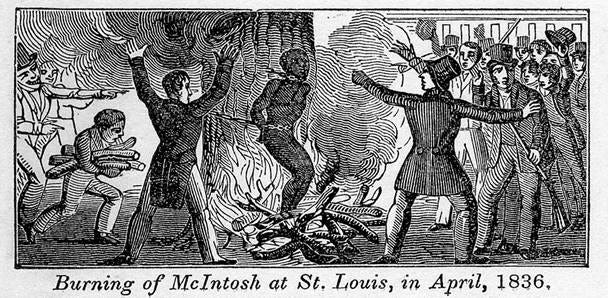
(Public Domain. https://commons.wikimedia.org/wiki/File:Burning_of_McIntosh.jpg)
A mob of several hundred arrived at the jail, seized McIntosh, chained him to a tree and burned him alive while he begged for mercy. During the brutal 15–20-minute ordeal no city official intervened. No one was ultimately brought to justice. Elijah Lovejoy witnessed at least the aftermath of the immolation.
This event was a major personal and professional turning point for Eijah Lovejoy. Outraged by the extrajudicial execution of McIntosh, in May 1836 he published an editorial in the St. Louis Observer denouncing those who killed McIntosh and those who did nothing:
When human life is thus wantonly taken—when the laws are set at defiance by a mob, and the cry of the innocent is disregarded—it is time for the friends of order to awake.
This editorial inflamed many in the city, who accused him of sympathizing with a murderer. The month he wrote the editorial his printing press was destroyed.
Lovejoy then moved his abolitionist paper to Alton, IL and named it the Alton Observer. His troubles, however, were just beginning. Illinois was not a slave state but that area of the state was dependent on the slave economy.
Although Lovejoy’s anti-slavery activism was inflamed by the McIntosh murder and he continued to demand the immediate end to slavery, his tone changed in other ways. For example, his anti-Catholic rhetoric significantly softened. In May 1837 he wrote in the Alton Observer,
Let not Protestants and Catholics contend as enemies. We differ—yes—but let the difference be discussed in charity. Violence and bitterness never convinced the mind nor converted the heart.
The inflamed mob ended Lovejoy’s life and advocacy
Lovejoy sensed the storm clouds gathering around him. In the weeks before his death he often spoke of martyrdom. He frequently referred to the words of Jesus regarding the need to sacrifice everything, even one’s life, to follow Jesus. As a man of faith Lovejoy was committed to losing his life for the sake of the dignity and liberty of black Americans and his own integrity.
Citizens and public officials tried to convince Lovejoy to leave Alton, Illinois, or to at least stop his anti-slavery rhetoric. In response, he gave a speech to a group of citizens in the fall of 1837 saying,
If I fall, my grave shall be made in Alton. It is not that I love strife, but peace founded on righteousness. I cannot yield the liberty of conscience and of speech which I hold from God.
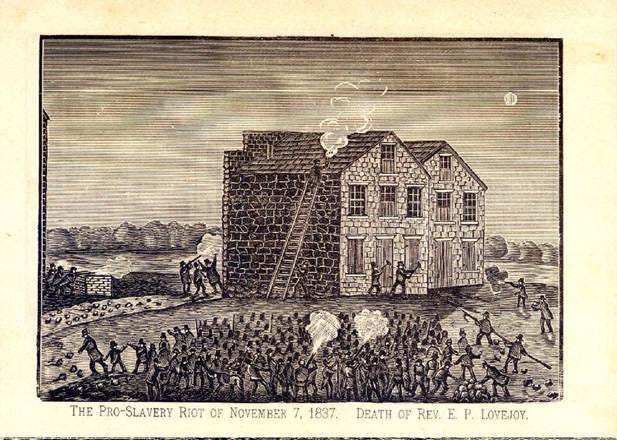
The destroying of the Alton Observer by a mob, 1837.
Public Domain: (https://en.wikipedia.org/wiki/Alton_Observer)
The tensions escalated to a climactic armed standoff at the Alton Observer on November 7, 1837. Elijah Lovejoy and his followers were defending the press against citizens who came to destroy it. Ultimately, the fourth and final printing press was burned, and Elijah Parish Lovejoy was shot to death.
Lovejoy’s final stand was a powerful demonstration of personal integrity and living the Gospel he preached, despite the ultimate consequence. His willingness to change, as evidenced by the softening of sectarian rhetoric and encouraging dialogue, is a testament to his commitment to Christian love.
Unfortunately, an angry mob, instead of accepting the invitation to dialogue and truth, chose violence and murder. Elijah Lovejoy’s final act was a culmination of a life lived for others, especially the most marginalized of his time.
The unfolding of the story of Elijah Lovejoy is simultaneously tragic and inspiring. It contains within it a core reality about human nature: we are capable of great good and profound evil. These collided in Lovejoy’s story. If we were in this story today, who would we be?
Further Reading
A more detailed discussion and analysis of the life and work of Elijah P. Lovejoy as a champion of the free press and civil liberties can be found in this comprehensive academic analysis.
J. Steven Bromwich is an investigative journalist who writes about culture, crime and human nature to help readers navigate modern problems with historical perspective and first principles. His background includes training and experience in criminal defense investigation, clinical ethics, nursing, and diplomatic studies. He is the founder of 1690 Media.