
Ida B. Wells: Fearless Investigative Journalist
Investigation of the lynching of Seay (CJ) Miller

By J. Steven Bromwich
A woman of action. A beacon of hope.
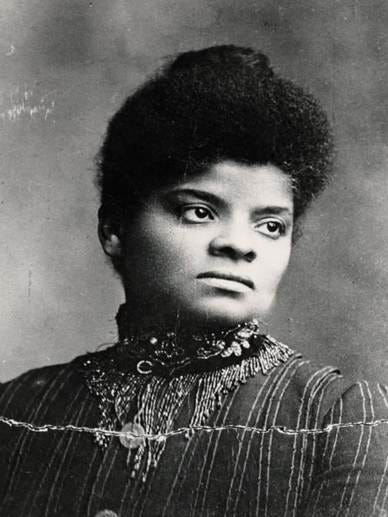
Public domain image.
Dear Miss Wells:
Let me give you thanks for your faithful paper on the lynch abomination now generally practiced against colored people in the South. There has been no word equal to it in convincing power. I have spoken, but my word is feeble in comparison. You give us what you know and testify from actual knowledge. You have dealt with the facts with cool, painstaking fidelity and left those naked and uncontradicted facts to speak for themselves.
Very truly and gratefully yours,
FREDERICK DOUGLASS
Cedar Hill, Anacostia, D.C., Oct. 25, 1892
(Public Domain: https://www.gutenberg.org/files/14975/14975-h/14975-h.htm)
Several decades before Rosa Parks refused to give up her seat on a city bus in Montgomery, Alabama, Ida B. Wells sat in a train car reserved for white ladies in 1880s Tennessee. When the conductor told her to move to the smoking car, she refused. She was forcibly carried out of the car by several men. This experience triggered her tireless and courageous life.
Born into slavery, raised with hope
Ida B. Wells was born into slavery in 1862 in Holly Springs, Mississippi. After emancipation, her father, James Wells, was politically active, despite often violent opposition. Both her father and mother, Elizabeth Wells, worked diligently to make a better future for their children through political activity, education and faith.
Ida’s parents and youngest brother died from yellow fever when she was only 16 years old in 1878. She took a job as a schoolteacher to support her surviving siblings and keep the family together.
Ida Wells’ spirit was formed by the example of her parents, formed in faith and education, and forged in hardship. Not surprisingly, Ida B. Wells became a successful journalist and formidable civil rights activist.
By the 1890s she began documenting, investigating and reporting lynchings. In 1895, she published The Red Record, Tabulated Statistics and Alleged Causes of Lynching in the United States. It provides a detailed account of her investigations.
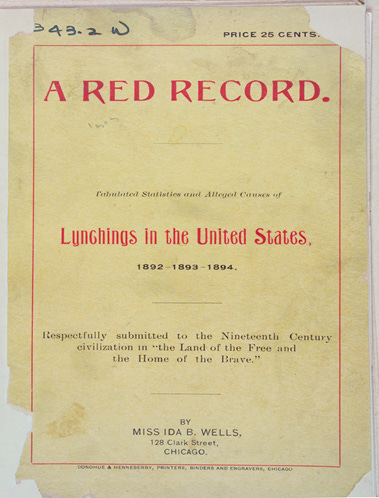
Public Domain. Retrieved from https://digitalcollections.nypl.org/items/9cb8c600-c609-012f-2e71-58d385a7bc34
Ms. Wells goes to Bardwell, Kentucky to investigate a lynching
Seay Miller (sometimes referred to as CJ Miller) of Springfield, Illinois was accused of brutally murdering two children, Mary and Ruby Ray, on July 5, 1893. A mob, deciding to play prosecutor, judge and jury lynched him without an investigation or due process. In fact, several key pieces of exculpatory evidence were ignored and at least one witness tampered with.
A search party was formed the same day to find the killer. In The Red Record Wells reports that two members of the search party, the Clark brothers, spotted a man running into a cornfield. The brothers fired at him, presumably assuming he was the killer, but the man escaped. The brothers reported he was likely a white man or mulatto.
Wells reports that the search continued all day. Blood hounds were secured and utilized in the search beginning at the scene of the crime. Interestingly, it was the use of the dog that began to solidify evidence favoring Miller’s innocence, facts that were ultimately ignored.
The investigation, timeline and evidence
The bloodhound led the search party to a fisherman named Gordon. Gordon stated he ferried a white man (or “bright” mulatto) across the Mississippi River at Wickliffe, Kentucky at 6:30 P.M. on July 5. The search party resumed the search with the bloodhound across the river at a place called Bird’s Point on the Missouri side. The dog ran to a farmhouse a few hundred yards from the river, stopped in front of a cottage, lay down and refused to move from that spot. The cottage belonged to a white farmer named Grant.
Wells recounts that a worker on a train in Sikeston, over 40 miles from Wickliffe, KY, discovered Seay (CJ) Miller stealing a ride on the train. There was a confrontation between Miller and the worker that resulted in Miller’s arrest at around 11:00 A.M. on Thursday, July 6.
Law enforcement claimed they found four rings on him, along with a knife and a razor, both of which were rusted and stained. It was claimed the rings belonged to the girls and had their initials on them. The authorities assumed he was the killer of the Ray girls.
The authorities in Sikeston, Missouri informed the Kentucky authorities they had captured Miller, describing his clothing, knives and rings. The Sheriffs from Bardwell and Carlisle Counties and a group of armed residents went to Missouri to retrieve him. Without a warrant, the Sheriff in Sikeston turned Miller over to Kentucky law enforcement when the group arrived on July 6. Miller told the Sheriffs and the posse that came for him that he had never been to Kentucky.
When the group and Miller arrived back in Wickliffe, Kentucky they called Gordon the fisherman to identify him. Before the identification, the Ballard Sheriff gave Gordon a warning that if the prisoner (Miller) was not the man, he would hold Gorden responsible for whoever committed the murders. Gordon stood looking at Miller from behind for a long time. According to Wells’ investigation, even though Gordon had previously said the man he ferried was white, he identified Miller, a dark, brown-skinned man, as the one he ferried across the river.
The crowd was ready to execute Miller immediately in Wickliffe, but John Ray, the father of the murdered girls, wanted Miller taken to Bardwell for justice. Ray stated he believed a white man murdered his daughters, not Miller. The mob took Miller to Bardwell but decided to skip due process and determine guilt themselves.
One of the Clark brothers, the brothers who spotted and shot at a white man running into a cornfield, changed his story. He identified Miller as the man they encountered, whereas the other brother said he was not. The testimony of the brother who identified Miller was accepted as the true account. Mr. Ray stated the rings found on Mr. Miller did not belong to his daughters, nor did they have the girls’ initials on them as previously asserted.
While the questioning was occurring, a crowd had been preparing for Miller’s execution, complete with a funeral pyre for burning Miller to death. They fully intended to torture and kill him. The biased investigation only had one conclusion. Confirmation bias assured only “evidence” of Miller’s guilt would be found. The mob was hot with passion and eager for an execution.
Miller was taken to the jail and stripped. No blood was found on his clothing or body. Even a red stain on the underside of his shirt was determined to be red paint.
The mob came to the jail to force a confession from Miller. He refused to speak to them except to continue asserting his innocence.
Even the mob’s rudimentary investigation revealed there was not even probable cause. First, the rings he possessed did not belong to the murdered girls. Second, the fisherman falsely identified him after being threatened by the Sheriff. Third, one of the Clark brothers changed his story (that the possible killer was white) and positively identified Miller, while the other disagreed with him. Fourth, there was no blood on Miller’s clothing. If he had cut two girls’ throats it seems likely their blood would be on him. Finally, Miller continued to declare his innocence and that he had not even been to Kentucky, much less to Bardwell, Kentucky, which is a full 51 miles from where he was found in Sikeston, Missouri.
Innocence, faith and the death penalty
Execution was inevitable and predetermined by the mob and those afraid of it. Miller requested a priest and when one was unavailable, a Methodist minister went to the jail and prayed with and baptized him. The minister encouraged Miller to confess. Rumors went around the inpatient mob that Miller confessed to the murders, but Wells reported that the minister, the Chief of Police and a leading editor, all with Miller at the time, said he never confessed.
The crowd descended upon the jail and dragged Miller out into the street. Mr. Ray implored the crowd not to burn him, as he was not convinced of his guilt. The mob compromised and decided to hang him instead.
A one-hundred-pound log chain was placed around Miller’s neck. He was paraded through the streets followed by a crowd of thousands. When he passed out (more than once) the mob dragged him. He was then hanged, shot, mutilated, and burned. Body parts were taken as souvenirs.
According to the reporting of Ida B. Wells in The Red Record, Miller stated: “My name is CJ Miller. I am from Springfield, Illinois; my wife lives at 716 N. 2d Street. I am among you today, looked upon as one of the most brutal men before the people. I stand surrounded by men who are excited, men who are not willing to let the law take its course, and as far as the crime is concerned, I have committed no crime, certainly no crime gross enough to deprive me of my life and liberty to walk upon the green earth.”
For more details on the life and work of Ida B. Wells see the collection at the University of Chicago library: https://www.lib.uchicago.edu/e/scrc/findingaids/view.php?eadid=ICU.SPCL.IBWELLS
J. Steven Bromwich is a writer, criminal investigator, and ethicist. He is the founder of 1690 Media, where he explores stories of American culture, history, ethics, and faith.