
When the mob arrives: vigilantism and damaged due process, then and now
When the mob and system get it wrong. The story of Seay (CJ) Miller

Content Warning: text and images portray graphic violence
By J. Steven Bromwich
The morning life changed
You did not expect this morning to be different than any other. You pour coffee, scroll your phone... and your world collapses. Messages from family, friends, co-workers, and your son fill the inboxes. Your heart begins racing so fast it might jump out of your chest. You feel cornered by a mob, an angry digital mob you cannot see.
The news of your son’s arrest has spread far and wide, before you even had a chance to wake up. You hesitate, but open Facebook. It is all there. When you look at the police blotter, you see more than a hundred comments, many with a similar theme: “Lock him up,” “I hope he dies,” “Loser,” “Jerk,” and worse, much worse. You have only been away from your phone for eight hours.
You run a search for your son’s name. His mug shot is plastered everywhere with the caption, “Arrested for assault and resisting arrest.” It looks bad. It sounds bad. But is he guilty?
It is all so overwhelming. Your only thought is to find and protect your son. “This accusation does not sound like my son,” you think to yourself. It cannot be true, but the digital mob and the storm are gathering.
They seem to not care whether he is guilty or innocent. They have no use for due process; their emotions have reached a verdict.
Who needs due process?
Similar scenarios unfold everyday across America. Once someone is arrested for a crime, law enforcement agencies often publish the arrest online where the media picks it up as part of local crime reporting. A sketchy looking mugshot sometimes accompanies the announcement of the arrest. The story and your mugshot follow you forever (or years), even if your case is dismissed or you are acquitted.
People check these sites sometimes for entertainment purposes, or perhaps to see if a neighbor or co-worker has been naughty, or maybe just to feel validated in their own virtue in the face of “evil.” Then the outraged mob rapidly gathers, like vultures circling a dying animal. People often have their reputations destroyed and graves dug long before they get a probable cause hearing in court.
This is not new behavior. What happens online today once unfolded on courthouse lawns, outside jails, and in public squares in towns and cities across the United States.
Vigilante justice is ruled by emotions. Due process is [most often] governed by reason.
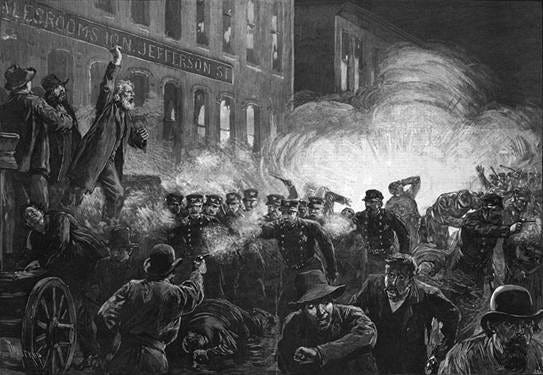
The Haymarket Riot, Chicago, 1886. Illustration from Harper’s Weekly. Public domain via the Library of Congress.
When the mob descended on Bardwell, Kentucky
Two young girls, Mary and Ruby Ray, were brutally assaulted and murdered while picking berries by their home near Bardwell, Kentucky. Their distraught mother found the older girl, believed to be 16 years old, with her throat slit. The children’s father, John Ray, found the body of his younger daughter, believed to be 12 years old, a short time later, also sexually assaulted and murdered.
The assaults and murders, not surprisingly, shocked and outraged the small town of Bardwell and surrounding area. The family and community rightly wanted to find whoever committed the heinous crime. The hunt was on.
Two witnesses gave a minimally helpful description: a white man running from the area near where the bodies were found. A posse assembled and proceeded to track the suspect with the help of a bloodhound. The group made their way from Carlisle County, Kentucky to Sikeston, Missouri. (Atlanta Constitution, July 11, 1893).
Outrage vs. due process
Despite the earlier witness description of a white man, Seay (CJ) Miller, a black man, was apprehended on a train car in Sikeston. Those who apprehended Seay Miller claimed he possessed a bloody razor blade, a knife and five gold rings, rings that supposedly belonged to the murdered girls.
Miller insisted he had not been to Kentucky. Evidence would later emerge substantiating his claim. According to accounts, there was a struggle, but Miller was overpowered by the group and transported by steamer to Wickliffe, Kentucky and then by train to Bardwell, Kentucky.
There are mixed reports of what happened to Seay Miller once he arrived in Bardwell. Some reports indicate he was in the custody of the sheriff for a brief time before being handed over to a mob that was demanding the accused man. Other accounts claim the mob never turned him over to the sheriff despite the sheriff demanding custody of him.
The precise details of the events are unclear, perhaps because the people spreading the news to neighbors and giving accounts to the newspapers were filled with rage and/or trying to justify the killing of the man they assumed was the perpetrator of violence against two little girls.
It is possible the authorities involved were reluctant to implicate themselves or anger their neighbors. Stories involving high emotions and drama tend to morph while spreading through small communities. Most of us have played the telephone game and have experienced this phenomenon.
What we do know is his arrest was questionable, there was a rush to judgment, an assumption of guilt, and a quick and violent execution. There was no due process.
Is it possible the real killer for whom they stopped looking got away and killed again? Were other little girls murdered because law enforcement failed to investigate and an irrational mob halted justice? There are consequences when an investigation is overcome by confirmation bias (only looking for evidence that confirms your belief) and justice ruled by an emotional mob. (Atlanta Constitution, July 11, 1893).
A crowd without faces
The mob was thirsty for retribution. Some arrived for the entertainment.
A reported 5000 people from Kentucky, Illinois, Missouri and Tennessee watched as Seay Miller was hanged, shot, mutilated, and burned despite his repeated protestations of innocence. Miller had no opportunity to defend himself. No one seemed to be listening. He was assumed guilty. No deliberation, just a quick, celebratory execution.
The mob was angry, irrational, and perhaps made assumptions about a black man assaulting and killing two white girls. Someone had to pay.
Immediately before he was hanged, Miller said, “I am not guilty.” Other accounts say he admitted to partial guilt and named an accomplice to the murders. Ida B. Wells, an investigative journalist who investigated the incident soon after the execution, discovered he never confessed. Again, there is a possibility the newspapers did not verify the information before publishing. This resulted in one-sided, self-justifying accounts of the events. (Atlanta Constitution, July 11, 1893).
Imagine standing on the scaffold, noose around your neck, a mob yelling, even celebrating, knowing you are innocent of the crime for which they are seeking vengeance? If only they really knew me, he may have thought. You may think of your spouse and children, as Miller likely thought of his family in Springfield, Illinois before his death.
Seay Miller’s wife and children in Illinois may not have heard the news of the accusation and execution of Miller for some time. They never had a chance to see him again, nor bury his body. It had been burned. There are reports that Mrs. Miller later had a mental breakdown.
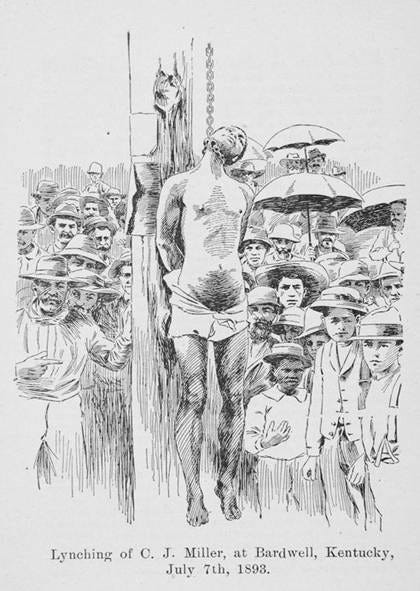
Public domain. Accessed at https://digital.lib.niu.edu/islandora/object/niu-gildedage%3A19817
Are we so different? Is there a lesson?
There is a lesson in the tragic story of Seay Miller. John Ray, the man whose daughters were assaulted and murdered, reportedly asked that Seay Miller receive due process. He apparently wanted a pause in the rush to execution to determine the truth, although there are differing accounts of what exactly he requested. It would be amazing if the man whose daughters were raped and murdered asked for restraint when most people would be consumed by blue hot rage. The was solid evidence, however, that indicated Miller was not the killer, and perhaps John Ray suspected someone else.
If the mob had listened to Ray, reason may have prevailed over passion. Seay Miller would have received a hearing. Would it have been fair? That is another question.
Crime and the public’s response
Is there a better way to report crime, one that does not destroy an “innocent until proven guilty” individual? Law enforcement usually puts a disclaimer related to this at the bottom of an arrest post, but does this make much difference?
Why do we so often assume that the accusation we hear or read is true? What is it about us that drives us toward condemning a person before we have heard the evidence? We want others to believe the best about us, yet we so often believe the worst about others.
Ida B. Wells: investigation of the lynching
Ida B. Wells was one of the bravest investigative journalists of her time. She travelled to Bardwell, Kentucky to investigate the accusation and execution of Seay Miller. She was a black woman investigating a white mob who executed a black man in rural Kentucky in the 1890s. She was driven by a desire for truth, despite the danger.
Ida B. Wells went where few dared go to seek and report truth. Did telling the truth about injustice and shining a light on human nature make a difference? It did.
In the next story we will present Ida B. Wells and the details of her investigation. Her investigation was thorough and vindicated Seay Miller.
J. Steven Bromwich is a writer, criminal investigator, and ethicist. He is the founder of 1690 Media, where he explores stories of American culture, history, justice, and faith.